|* books. "Women, Islam and Cinema" by Gönül Dönmez-Colin

"
Dönmez-Colin speaks of the insidious and conservative ways in which cinema in many Islamic countries has portrayed women. Her sweep is large: she covers India, Pakistan, Bangladesh, Malaysia, Indonesia, Iran, Turkey, Kazakhstan and Uzbekistan and draws careful analogies and contradictions that exist within and among these countries. Inevitably, cinema’s depiction of women as actresses, directors and spectators grows out of the prevailing social and political atmosphere: stifling patriarchy and female subordination." -
read more
|* cinema. Voices of Iraq VS Turtles Can Fly.
During
the POFF festival in Tallinn this year, we were able to see the movie from Iraq called "
Lakposhtha hâm parvaz mikonand" ("Turtle Can Fly"), 2004. I was lucky to watch another movie of this director before - "
Zamani barayé masti asbha" ("A Time for Drunken Horses"). I can say that his style of movies really appealed to me. It is different from any other movies, which show the difficulties and horrors of the war.
The director
Bahman Ghobadi is an Iranian Kurd and has a strong emotional bound to the issues of events in the Middle East. In his interview he said that while he was on his trip to finish and promote "A Time for Drunken Horses", he was shocked by the things he saw and decided to film as fast as possible. The movie was done in the very short period of time. I think that is the reason for it being so concentrated, powerful and touching. The story of "Turtles can fly" unfolds near the Turkey-Iran border and tells about the lives of orphans village. Children earn their living by collecting and selling the mines. I liked how the beginning and the end form the circle: in the beginning all chidren wait for the Americans, one boy asks: "Do you want to meet Americans?", in the end we get the same phrase, but the meaning is completely different. Now the American troops represent not the bright and perfect future, but the same hard times for Iraqi civilians again. I think that Bahman Ghobadi wanted to show that under the Saddam Iraq suffered. Then Iraqi people were promised future and fooled. There are, of course, pluses of the fall of Saddam, but there are many minuses of the way it was done and what it lead to.
In opposition to "Turtles can fly" I would suggest to watch "
Voices of Iraq", 2004. It is a documentary movie, which claim to have been directed by people of Iraq. For more information you can check
the official website of the movie. The movie is believed to create the new genre of cinema. The producers distributed more than 150 digital video cameras across Iraq to people, who filmed their everyday life and end up with more than 400 hours of footage. Later on it was edited and issued as documentary. There is a big controvercy over the whole matter. Those working in cinema or media can understand that having any raw material you can create any position you like through the means of editing. It is more than easy to choose the favoured opinions and to omit the unwanted ones.
There has been an interesting comment posted on the board of IMDB, with the topic "
Propaganda: Producers of this movie= ties to Bush Administration", which lead to many people arguing with each other. You need to register to be able to see the topic, but I will put a quote from that comment here:
"
If you do not think that this film has any political ties, then read some of this. The public relations group called Manning, Selvage & Lee (MS&L) (one of the largest U.S. public relations companies, estimated to have more than 1,000 employees and approximately $100 million in turnover)did publicity for this film. It happens to be the same group that runs all of those "ARMY OF ONE" ads for the U.S. Army. Don't tell me that this film was directed by "The People of Iraq." That has got to be the most misleading title EVER, and the PR Firm and the Producers should be ashamed of themselves for taking footage of these people, and editing it to the political message they wanted to push.[...]
Also, the film was produced with much help from "The Iraq Foundation," which provided all of the toture footage. They are located in Washington DC, and the foundation receives their funding from the State Department, which is headed by Colin Powell, a member of the Bush Administration..[...]
Independent Documentaries do not get funded by the Government and publicized by huge firms like "Manning, Selvage, and Lee." Look at their website, http://www.mslpr.com/"
What can I say from my side? Watch the two movies for yourself and make up you mind. I think that there cannot possibly be 100% true approach or representation of any subject, so it is always useful to look at all points of view. We can never be sure who is right and who is wrong. There will always be people for and against and it is not possible to make everyone happy at the same time.
|* cinema. Control Room, 2004.
What I consider to be very important in our world today is the opportunity to get information from different points of view. We live in the age of propaganda and media wars. We can never be sure that media coverage from one channel corresponds with the coverage from another channel. Politics use media to manipulate people's minds, trying to win the game. But the sufferings and the loss is among the civilians and that is the saddest truth.

One movie I would highly recommend to anyone interested in the media coverage on the war in Iraq, which started in 2003, is
Control Room. It is a movie about the role of the media, about the differences and similarities between opposing journalists and the media war. As
Samir Khader, the producer of Al Jazeera, stated in the beginning of the movie: "
You cannot wage a war without rumours, without media, without propaganda. Any military planner, if he doesn't put media propaganda at the top of his agenda, he is a bad militarist."
Control Room is the second film by Egyptian-American director
Jehane Noujaim (she co-directed 2001's
Startup.com with
Chris Hegedus). It is trully amazing that the director is a woman and that the decided to deal with such a hard issue as documentary on politics, and specially documentary on politics around the war in Iraq. My respect to her.
As written in the article of Chanel 4, "
Noujaim had intimate access to Al Jazeera's journalists and while there's no denying the channel's partisan position, the film avoids taking sides."
I got mixed feelings after watching this movie. It surely excited me, as I got the perspective on the war, but at the same time it horrified me.
It was shocking to know some facts. For example, that the US forces deliberatly bombed the position of Al Jazeera and two other arab channels in Baghdad just before the US troops came into town and "Iraqi" people took down the monument of Saddam. In the movie we get the same shots, but little bit from another angle and with comments. All "Iraqi" people going to the monument and portraying to be happy were of the same age, no women and coming together with the troops. There were no other people in the street. Noone else. All the scene looked very much being set up and fake.

A enjoyed the character of Al-Jazeera's journalist
Hassan Ibrahim, who was the head of Arabic news for the BBC before he joined al-Jazeera. Being very skeptical about the Bush administration, he is rather optimistic about the US Constitution and the American people. ("
The Americans will defeat the Americans. I have ultimate faith in the American Constitution.") Throughtout the movie he gave out many ironic comments and was always a person to make a sharp comment.
One more moment I would like to mention is when Al JAzeera is being criticized for showing the footage of dead American soldiers. The manager of AlJazeera.net,
Joanne Tucker, is accused of having a "position on the war". And she responds: "
Are any US journalists objective about this war? This word 'objectivity' is almost a mirage. If there was no agenda, if there was true neutrality there would be a welcoming of any and all information from all sides."
Of course, when Al Jazeera shows the footage of crying children and torn bodies, it has two reasons for that. First of all, there is a war going on and Al JAzeera is fighting on the side of the Arab interests. Secondly, they fulfill the requirements to translate news for more then 40 millions of Arabs and to match the expectations of them. All the media nowadays is build up like this in our market world.
Control Room is not a fancy documentary; it was filmed, I suppose, entirely on MiniDV, which has become the standard in home video cameras. The composition of some shots goes completely against all the rule of cinematography (like the shot where Samir Khader is giving a comment and you can see a big palm tree right behind his head, that makes his head look like in a funny outfit), but that is not the point. The point is that "Control Room" makes you stop and re-think many obvious facts. And it has sompletely succeeded in that.
|* caricature.

Is caricature a form of art? According to Wikipedia.Org:
"A caricature is a humorous illustration that exaggerates or distorts the basic essence of a person or thing to create an easily identifiable visual likeness."Caricature is a special art form that helps to point out the most important issues in a humorous way. There are many "funny" images that pretend on being called caricature, whereas in fact they are tasteless and stupid. The real art of caricature includes professional approach, talent to see the subtext and sharp eye for the unexpected points. Usually caricature becomes popular during the political and social changes or important events. It is the way to make people pay attention by using the strongest wearpon - humour. There are many characteristics for a good caricature: a metaphot, grotesque, extra-ordinary and sharp solutions and independent thinking about government and society. Of course, sometimes caricature, as any other form of art, can be used as propaganda, creating a particular stereotype.
Today caricaturists in Saudi hope for more freedom to express themselves with the means of their works. From the article published in Middle East Online:
"Caricature is about drawings accompanied with small comments, but has large meanings either to mock or criticize." Many caricaturists in the Middle East admit that the World Wide Web has helped to make caricaturists' voices to be heard all over the world.
I would say that caricature is unique, because sometimes it is enough to look at one caricature and understand the main point and the whole situation instead of reading through numerous articles on the same topic.


I personally like the works of the cartoonist
Jeff Danziger

see more of them
hereAs and old Chinese proverb goes: "a picture is worth ten thousand words"
|* music. Arabic music, free download
Long time I haven't posted any links to music composition. Well, I have very good news. Recently I found a perfect music portal with thousands of mp3s all available for download. The only requirement is registration (you don't have to pay anything, just put in some info about yourself and enjoy music)
Mazika - The Arabic Music GatewayPlus different polls, albums reviews, forum and the hit list of the hottest songs.
P.S. I would reccoment Amr Diab that
once I already wrote about.
|* funny middle east
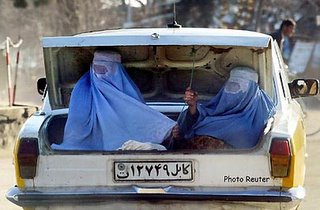
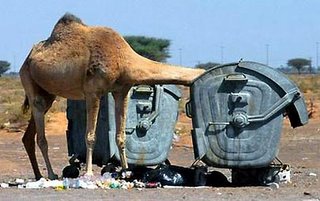
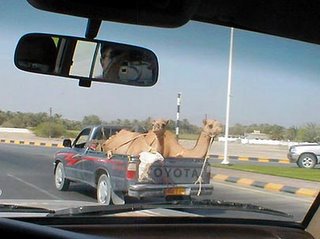
There are many funny things about the Middle East. Just have a moment and give some photos a look :)

|* photos. Yemen
The following photographs are mady by a groups of Russian tourists, who visited Yemen in February 2004.


 (c) Gallery
I was amazed by these photos! It feels like a totally different world. I would believe more that it is somewhere on another planet. It was even more interesting for me to read about the trip. I translated some main points-observations about Yemen:
It is hard for a foreigner to get some sleep there. Usually streets are busy till 23 o'clock. Cars are driving with a necessary constant honking to everyone and everything around, including cars, people, dogs or any kind of crossroad. After 23 o'clock cars disapper, but people keep on talking to each other, but in such high voices like we use to shout from a long distance. When people disappear as well, dogs are left, which bark almost all the night. And early in the morning, around 5 o'clock, they start the first praying.
It is typical for the people to carry guns and Kalashnikov.
Jambiya is a must-have kind of thing.
The building of a house in Yemen starts with an installation of a door. Then the rest of the house is built.
If you try to take a photo of a woman and she notices you, she will start to throw stones at you!
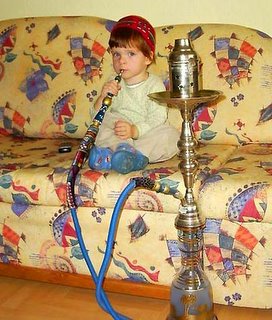
Smoking
hookah in Yemen is not respected and considered to be unhealthy. Therefore, everyone chews "
Khut" and around noon all men rush to market places, where they sell khut. Khut is being chewed and put aside behind a cheek during several hours. So somewhere close to the evening all men look rather funny with a khut behind their cheeks (like they have stuffed there a whole apple!)
Sometimes you can see a goat standing on the top of a car eating its breakfast - leaves from a tree next to the car.
|* calligraphy. Mohamed Zakariya.

Once I saw a movie by a British director
Peter Greenaway called "
The Pillow Book". Since then calligraphy and the art of writing facinates me. When doing the daily search for interesting things about the art of Middle East, I found the website of
Mohamed Zakariya, who is an Islamic calligrapher, artist, as well as a master woodworker, engraver, and machinist.
Zakariya also gives lectures lectures on Islamic calligraphy and has presented numerous workshops. His calligraphic works have been exhibited widely all over the world. Mohamed is the author of numerous articles and monographs. Apart from all that Zakariya also designs and constructs functioning examples of antique-style scientific instruments. Examples of these instruments can be found in the collections of the Aramco Science Museum in Saudi Arabia, the National Museum of Qatar, the Time Museum in Rockford, Ill., and the Adler Planetarium in Chicago.
In the picture above you can see the phrase "Muhammad, Peace and Blessings Upon Him (in Arabic)" That is the name of the Prophet and his prayer of blessing.
Isn't it amazing? Words blur into a pattern inviting a viewer for a tour into the world of harmony and beauty of the lines. Writing became a visual art form. The purpose is not only transferring the words as they are, but creating subtext, hidden meaning, emotions. The calligrapher can create things out of words, as they become objects, even more, they become living things. The act of writing then is a long creation process, meditation on life, Art with the capital "A".
|* cinema. Syriana - George Clooney in the Middle East again
All the coincidences amaze me more and more. I happened to search for news on George Clooney without any reason and the first articles I got was about a movie set in the Middle East. I went to the IMDB to check up on it and found out it was the movie of the hour, all animated advertisements were showing this movie. Well, what is it about?

A famour scripwriter
Stephen Gaghan ("
Traffic" 2000), who specializes on the burning issues of the day, is trying his strengths again in being a director of a movie. In 2002 he made his début with a thriller "
Abandon", and this time it is a political thriller "
Syriana" (2005). The basis for this project are the memories of a CIA operative Bob Barnes, which he wrote down in a book "See No Evil: The True Story of a Ground Soldier in the CIAs War on Terrorism". The topic is the constant activity of the USA in the countries of the Middle East. And the main role is played by George Clooney. Aparently, he became interested in politics of the Middle East after he played in the movie "
Three Kings".
I am more then eager to watch this movie.
|* cinema. Black Night Film Festival 2005. Poff.

Do you know why I love the end of the Fall term? As a normal student of course I just hate the workload, deadlines and exams, however, there is such a perfect reason to enjoy life during this time. And the reason is
the Black Night Film Festival aka POFF in Tallinn. This year it happens from the 2nd till the 11th of December.
There are a number of movies from the Middle East countries presented:
- 20 Fingers (Beest Anghosht) Iran, Great Britain 2004
the issues of men and women within the confines of the traditional and family life in Iran - Earth and Ashes (Khakestar-O-Khak), Afghanistan, France 2004
the old man’s journey to find his son, the story takes on the nature of a parable of desperation caused by destructive loss, and of the need and ability of the human spirit to face the horrors of war. - Iron Island (Jazireh Ahani) Iran 2005
a fast-paced tale about poor people in the Persian Gulf living aboard a sinking oil tanker - The Unwanted Woman Iran 2005
reveals opposition and clashes in relations - Turtles Can Fly (Lakposhta Ham Parvaz Mikonand) Iran, Iraq 2004
a refugee camp on the Turkish-Iraqi border where Kurds have fled from the surrounding villages. This is the other face of war, full of blood, fear and pain, which can turn a child’s heart to stone - Magia Russica Israel, Russia 2004
Fjodor Chytruk is one of the greatest Russian animators. The movie moves between the sights and sounds of Russia, and into the animated films. - To Take A Wife (Ve Lakachta Lecha Isha) Israel, France 2004
The story revolves around the home and the family, and describes the three days of preparation for the Shabbat - Waiting For The Clouds (Bulutlari Beklerken) Turkey, France, Germany, Greece 2004
Drawing on the novel Tamama by Yorgos Andreadis, the story takes place in the 1970s in the Turkish fishing village of Trebolu on the shores of the Black Sea, not far from the Soviet border
|* music. 'La Ya Amman' - Song condemning the terrorists attacks
Before I wrote that Moustapha Akkad died in the terrorists attacks in Jordan. Thanks to the blog
Mental Mayhem I come upon the
link to the Song "
La Ya Amman". The song is performed by several Jordanian singers (Zein Awad, Nany Petrao, Fadi Ghassan...) and condemns these attacks.
It is possible to
download the song here. And now there has been a video made for this song, you can
download it here.
|* cinema. Three Kings (1999)
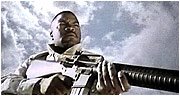 In a war without heroes they are kings Troy Barlow
: Are we shooting?
Soldier: What?
Troy Barlow: Are we shooting people or what?
Soldier: Are we shooting?
Troy Barlow: That's what I'm asking you!
Soldier: What's the answer?
Troy Barlow: I don't know the answer! That's what I'm trying to find out!... I think this guy has a weapon! Yeah, he does!
Shoots the guy, comes closer, sees that the guy had a white flag. Personally, I think there is the right time for everything. I know for sure that in the year 1999 this movie was made, I wouldn't be able to understand it, yet enjoy. Recently I came upon "I heart Huckabees" by
David O. Russell and went to movie database to check for his works. Guess what? I found out that "
Three Kings" my brother liked so much many years ago, is not actually a stupid-hollywood-action movie. Now that I watched it, I can say the crew did a great job! Sharp dark humour, great plot, dramatic moments mixed with hard action and irony, what more to wish?
The story goes back to 1991, when USA libirated Kuwait and declared that the war was over. People are happy, journalists are there to cover the celebration story, soldiers are drinking like hell, dancing and singing "I love this land. God bless the U.S.A.!" But next day, while arresting more Iraqies, they found a map in on Iraqi guy's ass! Well, later on rumours claimed it was in his penis. Or ear. Or nose! Maj. Archie Gates (
George Clooney) goes to a "proctology" tent and gets a deal with the soldiers who have found the map. Four of them go and search for the bullions (not the little cubes you make a soup from) in the secret bunker. To make the story short, they did find the gold, but they also saw hundreds of people suffering, Iraqi Shiite civilians who have risen against Saddam Hussein, have been promised help from USA and abandoned. I think you already guessed what happens next: our brave three soldiers cannot just stay away with their gold, they try to help and save!
Basically, it is a movie about soul transformation of these guys. They got into Iraq, didn't do much, were supposed to be send back already, but went for the gold. Saw injustice, changed their "necessity", tried to help, failed in some way, in some way succeeded, but definitely looked over their beliefs and got educated on the true and selfish reasons of USA for war.
Thanks to the lecture of James Thurlow "Media Criticism" this term, I've learned what inoculation is according to Roland Barthes in his essay "Myth today" and "Operation Margarine". Well, this movie is a perfect example of inoculation.
While making a small research on this movie before writing a review, a came upon interesting facts.
- First, all the movie was shot in Arizona, and the director even sent two guys sectretly sneak in Iraq to take photos of the real area in order to find the best places in USA to film it.
- Then, do you remember the scene with the torture of Troy Barlow (Mark Wahlberg)? Well, he wished to get into role and asked to make it for real! Respect.
- I was laughing when I saw the propaganda leaflets with pictograms the USA oficer used to make Iraqi soldiers surrender. I was surprised to know they are actually the real ones used in the Gulf War! It reminded me the leaflets for American soldiers I came upon in the Internet searching for the Kurdish-English dictionary.
- The film was banned in Iraq.
- On the official website of the movie you can find a special presentation, "HOW TO SHOOT A SCENE WHERE YOU BLOW UP A HELICOPTER WITH AN EXPLODING FOOTBALL." The feature includes a detailed shot list, storyboards, production photos and sketches.
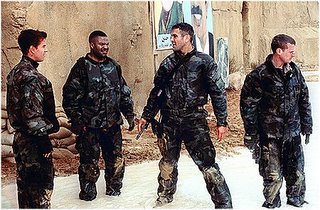 Moments to remember? Here we go:
- Cow being blown by the mine.
- Explanation of how a bullet tears into the gut. Or lungs being sqeezed by the air pressure.
- Milk truck shot through and the milk just pours outside, Iraqi people drinking it from the ground.
- Children running through the mine field and Mark Wahlberg running after them to stop (reminded me the scene from "Turtles can fly", movie from Iraq, where the child is so close to step on one).
- Sadam's soldier telling about his son being killed by USA troops while bombing, and his wife lost her legs. That makes a great impression on the Wahlberg. In fact, I so much liked how Mark played in this movie! I can say that his character somehow partly transfered to the new "I heart Huckabees" movie by the same director, where he played the guy being totally depressed by the cruelty of this world and strongly against usage of oil.
What else? An American football ball turned into a bomb and being thrown at the Sadam's helicopter, Bang!
And Gucci bags! Oh yeah, man, Gucci bags full of gold!
|* dance. art of Belly Dancing.

What image pops up in your head when you hear “Belly dance”? Mystery, exoticism, erotica, seduction… ? Girls dancing in the sparkling light apparels, tempting clinking sounds of coins on their belts and the atmosphere of relaxing and pleasure. That is a true delight to watch a skilled minx hypnotizes you into fairytales of 1001 nights with the dance.
However, neither language in the Middle East uses the name of any part of the body. In Arabic this dance is called "
raqs sharqi" and in Turkish - "
Oryantal tansi". The translation of both terms is "dance of the East", or "Oriental dance". Calling this form of dancing a "belly dance" might be considered vulgar by many Middle Eastern people.
As the history goes, the origins of the Oriental dance are in North Africa, the Middle East, and as far east as Iran. Some say it might have been used to support childbirth.
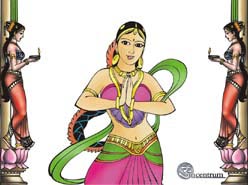
In the beginning the Oriental dance was performed primarily in family-oriented events like weddings, circumcisions, bar mitzvahs (don't be surprised, Jewish families did it too!), and other occasions. Outsiders were rarely given any opportunity to witness it.
During the 19th century, Europeans became fascinated with "the Orient" and the word quickly spread that the dancers were one of the must-see attractions.
Whether they enjoyed the dancing or despised it, the exotic appeal of something so very different from their own homeland held a sort of fascination for them. Although previously the local women had danced only for family celebrations and community events, they discovered a new market for their talent: foreigners.The nightlife in clubs for the Oriental dance spread first in Cairo, Egypt, in the 1920's. Soon the same clubs also appreared in Beirut, Lebanon. Tourists wanted to spice up their lives with something exotic and thus musicians and dancers market flourished.
But enough of facts, what do we have today? Sometimes people still wrongfully regard "belly dancing" as similar to stripping, but luckily there are not a lot of those people. We have numerous places to learn the Oriental dance and, in fact, to keep fit doing it.
Have you ever tried belly dancing? If you did, you would probably know that it requires a very good stomack muscles condition. The first time I tried it, I couldn't move my hips, they were not shaking! I felt like Miranda in one of the Sex and the City episodes, when she complained to Carry that she would never be a girly woman, because her hips wouldn't pump. Finally, I had to practise every day for several weeks my stomack press in order to get my belly shaking.
The accident happened with
Susan Sarandon while she was practising the erotic dance moves for her new film 'Bernard and Doris'. Apparently she tried too hard and injured her back. That's again indicating that it is not so easy as it seams. Or that if you are 59 years old, it's better not to risk, even if you are a movie star.
P.S. places to learn Oriental dance in Tallinn, Estonia:- Ehitajate tee 109 a
tel 56637350, Maria
on Saturdays at 14.30
|* celebrities. Angelina Jolie in Pakistan
 Angelina Jolie
 and her boyfriend
Brad Pitt spent their Thanksgiving in Pakistan. Jolie has been the UN Refugee Agency's goodwill ambassador since early 2001. Her four-day mission in Pakistan will help to focus world attention on the plight of over three million Afghan refugees.
After the actress visited the devastated parts of the disaster zone, she was so shocked that she decided to consider adopting a child there. Jolie, who has already adopted two orphans - a boy Maddox from Cambodia and a girl Zahara from Somalia, finds it to be a special thing: "There's something about making a choice, waking up and traveling somewhere and finding your family".
The actress is very worried about the future of more than three million Afghan refugees, who are still sheltering in Pakistan 25 years after war forced them to flee their native land.
"They’re very far out and they are very concerned about the winter coming", Jolie reminded.
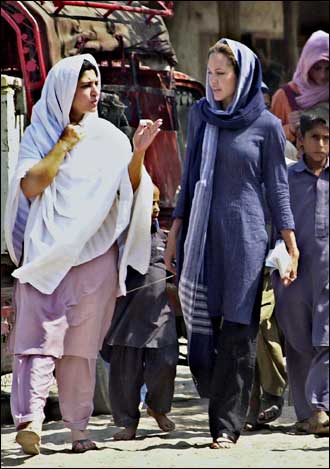
By the way, during her visit, Jolie paid respect to the traditions of the place and was wearing
salwar kameez and
dupatta on her head. It is nice to know that apart from being rich and famous, some movie stars are concerned about tragedies in the world and try to help.
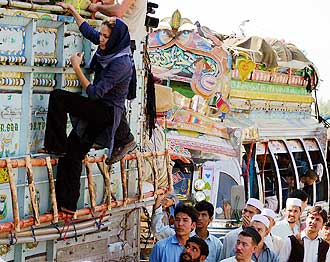
This photo I found to be rather interesting. Here Jolie climbs aboard a bus carrying Afghan refugees back to Afghanistan during her visit to the Kacha Gari refugee camp in Peshawar (Reuters Photo). Looks like her training for both Tomb Raider and Mr. and Mrs. Smith movies is not in vain.
Find more pictures
-here-
|* architecture . Zaha Hadid and Phaeno Science Museum in Germany.

On Friday, November 25, there was a big opening of a grand Science Museum in Wolfsburg, Germany.
The Science Center, Phaeno, is the first of its kind in Germany and presents to the visitors mysterious strangeness ruled by a system of structural organization. As it is said in the official press release, the building is structured in such a way that it maintains a large degree of transparent and porosity on the ground and an artificial crater-like landscape allowes diagonal views to the different levels of the exhibition-scape.

This entire alien-like wonder is designed by
Zaha Hadid, a female independent practitioner among today's most elite architects.Born in Baghdad, Iraq in 1950, Hadid received her degree in mathematics from the American University in Beirut and studied at the Architectural Association in London, where she won the Diploma Prize in 1977. Upon graduation Hadid became a partner in the Office of Metropolitan Architecture, where she worked with influential architects
Rem Koolhaas and
Elia Zenghelis. Establishing her own practice in London in 1979, she soon gained international attention with her controversial winning entry for the Peak International Design Competition for Hong Kong in 1983.
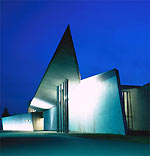
Hadid was the only woman included in the Museum of Modern Art's 1988 Deconstructivist Architecture exhibition. Her first physically-realized project, the Vitra Fire Station in Weil am Rhein, Germany, spinned her career to a new phase. This small structure, which has been characterized as "frozen motion," reflects Hadid's frequent use of unusual shapes to integrate a building with its environment.
Some other works:
Rosenthal Center for Contemporary Arts, Cincinnati, Ohio Center of Contemporary Art, Rome, Italy
I was trully amaized by her design and innovative ideas, as Hadid is consistently pushing the boundaries of architecture and urban design and experimenting with new spatial concepts. And last, but not least, in 2004 Zaha Hadid became a
Laureate of the Pritzker Architecture Prize marking the first time a woman has been named for this 26 year old award.
more info on Zaha Hadid and her project can be found:
* on
her official website* in the
Online Media Kit from the Pritzker Architecture Prize website*
ARCspace.com
|* how is it to be rich in the middle east way?
I am fully aware that it doesn't have any connection to the art (well, at the same time, who knows? maybe it is art to be rich and to show off), but I came across the photos of the plane of King of Jordan, and I became speachless...
The story of living in style or no limits for the kings...
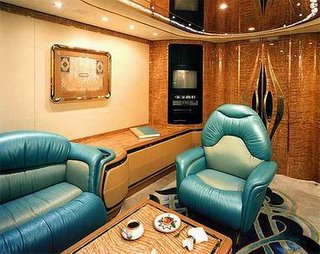
more photos are available
here.